
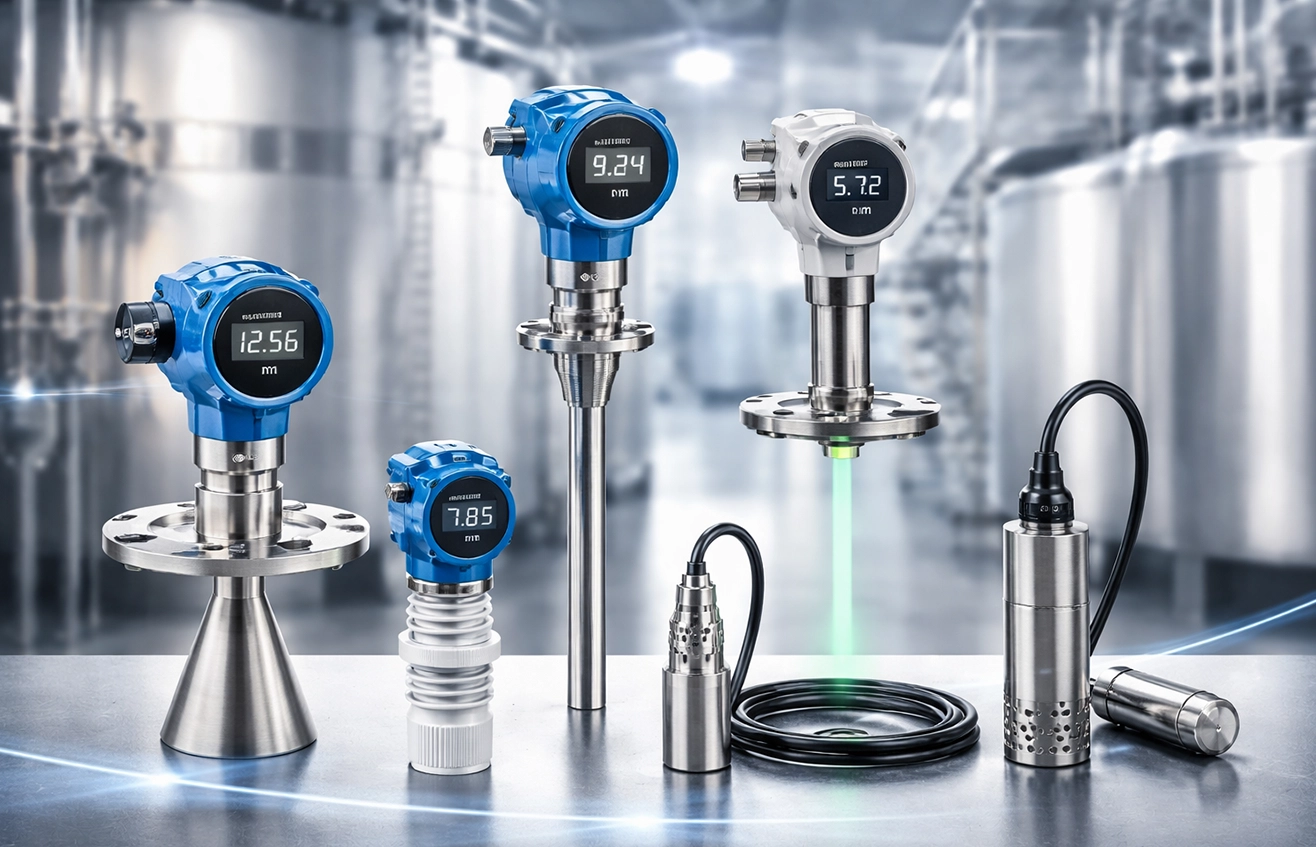
Our Level Measurement include
Float level switches - A Float Level Switch is an instrument that detects liquid level by using a float that rises or falls with the fluid, activating a mechanical or magnetic switch. The main types include reed switch float level switches (magnetic float actuates a reed switch), mechanical lever float switches (float movement operates a mechanical contact), and multi-point or continuous float sensors (for multiple level detection or continuous monitoring). Float level switches are widely used in industries such as water treatment, chemical processing, oil & gas, and HVAC systems to provide high or low-level alarms, pump control, and tank protection. They are valued for their simplicity, reliability, and suitability for a wide range of liquids and tank configurations.
Ultrasonic level sensors - A Ultrasonic Level Sensor is an instrument that measures the level of liquids or solids by emitting ultrasonic pulses and calculating the distance based on the time taken for the echo to return. The main types include fixed-mount ultrasonic sensors (installed at a fixed height for continuous level monitoring) and submersible ultrasonic sensors (immersed directly in the fluid for point or continuous measurement). Ultrasonic level sensors are widely used in industries such as water and wastewater treatment, chemical processing, food & beverage, and storage tank monitoring. They provide advantages like non-contact measurement, suitability for corrosive or dirty liquids, and easy installation in tanks, silos, and open channels.
Radar level transmitters - A Radar Level Transmitter is an instrument that measures the level of liquids or solids by emitting microwave radar signals and calculating the distance based on the time delay of the reflected signal. The main types include guided-wave radar transmitters (signals travel along a probe for precise measurement in confined spaces) and non-contact or free-space radar transmitters (signals travel through air, suitable for large tanks and silos). Radar level transmitters are widely used in industries such as chemical, oil & gas, power generation, and food & beverage for continuous, accurate level monitoring under harsh conditions like high pressure, temperature, or vapor. They offer advantages of high accuracy, non-contact operation, and reliable performance with corrosive, foamy, or turbulent media.
Differential pressure (hydrostatic) transmitters - A Differential Pressure (Hydrostatic) Transmitter is an instrument that measures the level of liquid in a vessel by sensing the hydrostatic pressure difference between the bottom and reference point of the tank. The main types include remote-sealed differential pressure transmitters (for high-temperature or corrosive liquids using capillaries and diaphragms) and direct-mount DP transmitters (installed directly on the tank for standard applications). These transmitters are widely used in industries such as chemical, oil & gas, water treatment, and power plants for tank level measurement, flow measurement, and interface detection between liquids. They provide accurate, reliable, and continuous level monitoring, enabling safe process control and integration with automation systems.