
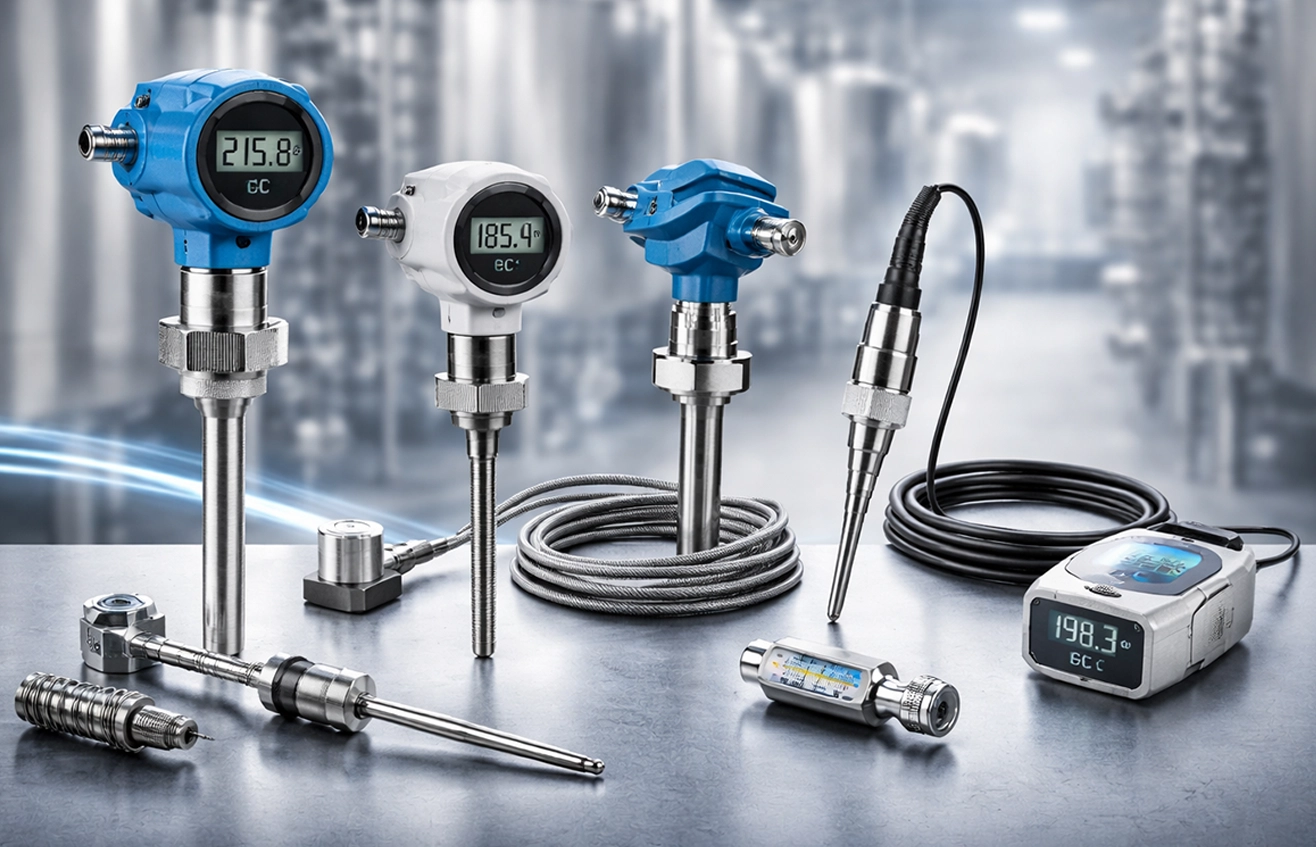
Our Temperature Measurement solutions include
Thermocouples - A Thermocouple is a temperature-sensing device that generates a voltage proportional to the temperature difference between two dissimilar metal junctions. The main types include Type K (Nickel-Chromium/Nickel-Alumel) for general-purpose high-temperature measurement, Type J (Iron/Constantan) for moderate temperatures, and Type T (Copper/Constantan) for low-temperature applications and cryogenics. Thermocouples are widely used in industries such as oil & gas, chemical, power generation, and food processing for furnaces, boilers, reactors, and heat exchangers. They offer advantages of wide temperature range, fast response, durability in harsh environments, and suitability for both contact and embedded applications.
RTD - A RTD (Resistance Temperature Detector) is a temperature measurement device that determines temperature by measuring the change in electrical resistance of a metal, typically platinum, with temperature. The main types include Pt100 RTDs (resistance of 100 ohm at 0 deg C, used for long-distance signal transmission), and wire-wound or thin-film RTDs (for high-accuracy and fast response applications). RTDs are widely used in industries such as chemical processing, pharmaceuticals, food & beverage, and power generation for precise temperature measurement in boilers, reactors, heat exchangers, and process control systems. They provide high accuracy, excellent stability, and repeatability, making them ideal for critical industrial temperature monitoring.
Temperature transmitters - A Temperature Transmitter is an instrument that converts the signal from a temperature sensor, such as a thermocouple or RTD, into a standardized electrical output (commonly 4-20 mA or digital) for process control and monitoring. The main types include thermocouple-based transmitters (for high-temperature applications), RTD-based transmitters (for high-accuracy measurement), and universal transmitters (compatible with multiple sensor types). Temperature transmitters are widely used in industries such as oil & gas, chemical, food & beverage, and power plants to enable remote monitoring, integration with PLC/DCS systems, and precise temperature control of processes. They enhance measurement accuracy, signal stability, and system reliability while facilitating automation and safety in industrial operations.
Infrared/pyrometers - A Infrared/Pyrometer is an instrument that measures temperature by detecting the infrared radiation emitted by an object, enabling accurate readings without physical contact. The main types include spot pyrometers (measure temperature at a specific point), line or scanning pyrometers (measure temperature along a line or moving surface), and infrared thermal cameras (provide a full-area temperature profile). They are widely used in industries such as metal processing, glass manufacturing, ceramics, and power generation for furnaces, molten metal, kilns, and other high-temperature processes. Infrared/pyrometers offer fast, non-intrusive measurement, making them ideal for hazardous, moving, or extremely hot environments where contact sensors are impractical.